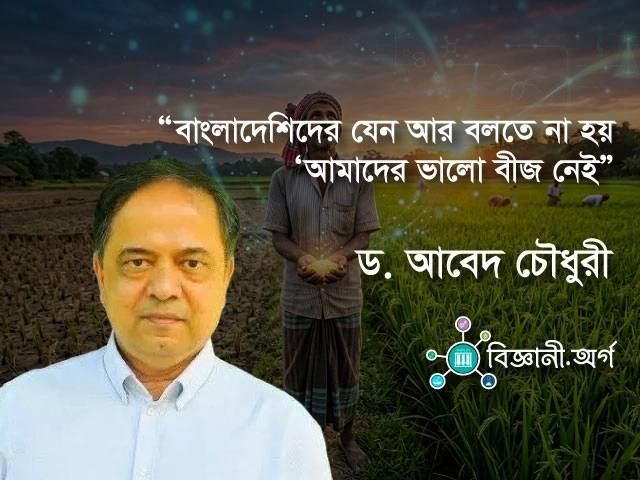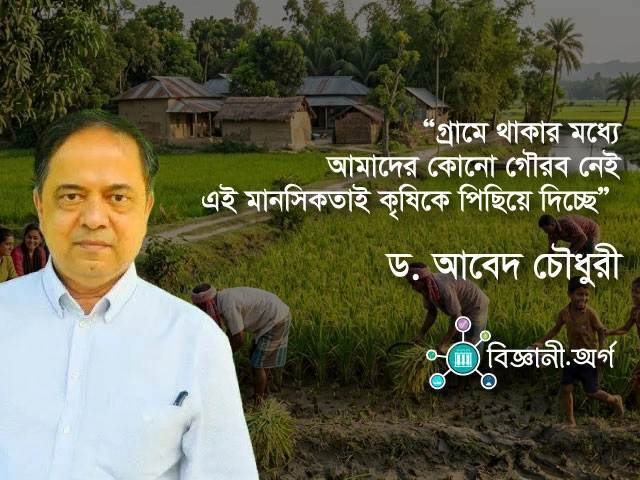
Whenever we talk about the problems facing agriculture in Bangladesh, we usually mention seeds, fertilizers, irrigation, or natural disasters. But there’s a deeper, quieter cause behind all this—our social mindset. The way we perceive villages and agriculture often determines the future of farming itself. According to botanist Dr. Abed Chowdhury, “Our lack of pride in living in villages is what’s holding agriculture back.” His words sharply reflect the social realities of Bangladesh.
Urban-Centric Prestige and the Culture of Neglecting Villages
For a large portion of Bangladesh’s educated and middle-class, “success” means living in the city, attending good urban schools, and being established in urban professions. Living in a village is often subconsciously viewed as “falling behind.” Words like “rustic” or “country” are frequently used as insults in our conversations. This language is not just words—it’s the manifestation of a mindset.
Dr. Abed Chowdhury believes that because of this mindset, issues facing villages and agriculture don’t receive enough importance from policymakers and the intellectual class in cities. Seminars on agriculture are held in cities, research papers are written, but there’s often little direct connection to the daily struggles of rural farmers. As a result, policymaking around agriculture remains more of a theoretical exercise than one grounded in real needs.
The Urban Migration of Talent
Another major outcome of this urban-centric mindset is “talent drain”—the steady flow of bright young people from villages to cities. Those in villages who do well academically and get opportunities to study naturally move to cities. Very few return to work on agriculture or local development in the villages. This pushes the villages further behind and limits the adoption of modern ideas and technology in agriculture.
Dr. Abed Chowdhury notes that in developed countries, there exists a mutually respectful relationship between urban and rural areas. There, living in a village isn’t seen as falling behind. In fact, rural agriculture, environment, and lifestyle are often sources of pride. Bangladesh also urgently needs a shift in perspective.
Seeing Agricultural Issues as “Our Own Issues”
According to Dr. Abed Chowdhury, the root cause of agriculture’s neglect is a kind of psychological distance. People in cities often view agriculture as “their problem,” not “our problem.” So, issues like farmers’ hardship, floods and droughts, and unfair crop prices might generate fleeting discussions, but long-term solutions are rare.
He believes that to bring agriculture to the heart of national development, we must first break down this mental divide. There needs to be a culture of viewing both rural and urban people as members of the same country. Agriculture is not just for villagers; it’s the foundation of the nation’s food and economy.
A Call to the Youth: Looking Back to the Village
Dr. Abed Chowdhury’s advice is simple yet deeply meaningful. He urges the children of educated urban families to go to villages and befriend the local children and teenagers. Experiencing nature firsthand, understanding the lives of farmers up close—these experiences can transform young people’s perspectives. Through this, instead of seeing the village as “other” or a distant world, one can begin to feel it as an inseparable part of our own society.
Such a change in mindset can lead to the rise of future leaders who will not neglect agriculture but will see it as the driving force behind development. Whether as scientists, policymakers, or entrepreneurs, decisions rooted in connection to the country’s land will always be more humane and realistic.
Conclusion
Changing the mindset that belittles villages and agriculture is not just for the benefit of farmers; it’s essential for the country’s overall development. Dr. Abed Chowdhury’s statements are a reminder to us all—solving agricultural problems is not just a matter of technology or policy, but fundamentally one of social mindset. If we can change this mindset, agriculture and rural life in Bangladesh will gain a new sense of pride and dignity.
Read the full interview with Dr. Abed Chowdhury: