Chapter – 3 (In the Land of Sleep)
State of Sleep: Sleep is divided into two main phases—Non-Rapid Eye Movement (NREM) and Rapid Eye Movement (REM) phases. NREM is followed by REM, which in turn is followed again by NREM. Human sleep happens in cycles—a complete 90-minute cycle consists of one NREM and one REM phase. As the number of completed cycles increases after falling asleep, the duration of each REM phase within a 90-minute cycle gradually gets longer.
Non-Rapid Eye Movement (NREM) Phase—This phase is divided into three stages.
First Stage—
Beneath the temporal lobe on each side of the brain is the hippocampus. In this stage, though the eyelids are closed, the neural loop near the visual cortex (serving as short-term memory for visual data) begins sending appropriate visual data to the hippocampus for long-term memory, keeping the loop’s neurons active and mildly yet continuously stimulating the eye’s tonic muscles, resulting in slow eye movement. When one transitions from alert awake state to this first NREM stage, the hippocampus receives visual data from short-term memory and emits higher frequency theta waves (hippocampal theta waves), which help the brain track the current spatial location of the person.
Near the brain’s midline in the midbrain is a cluster of neurons called the “ventral tegmental area.” The dopaminergic neurons (dopamine-producing) here need to become active in order for us to wake up. In the first NREM stage, these neurons are generally slightly active, and waking up from this stage often feels like we were awake all along.
The motor cortex, cerebellum, basal ganglia, pedunculopontine nucleus (in neuroscience, a nucleus is a cluster of neurons serving the same function), red nucleus, and subcortical motor nuclei use various motor neurons to stimulate our skeletal muscles and glands as needed. Muscle stimulation is of two major types: tone and tension. For lifting, lowering, pushing, or pulling, muscle strength is more needed than flexibility—that’s where muscle tension is important. For maintaining balance when standing or walking, or to reduce energy expenditure while lying down, muscle tone is increased, especially by the cerebellum. The cerebellum also controls the muscles in the airway leading from the nostrils to the vocal folds, helping to regulate breathing by sending muscle tone for a linear airflow path. At the start of sleep (NREM, stage one), the cerebellum reduces tone in the upper airway muscles to save energy. (That’s why airflow in the upper airway during NREM is less linear, and more air hits against the airway walls, making normal breathing noisier—we call this “snoring.”) Occasionally, the cerebellum momentarily increases muscle tone in some arm or leg muscles [since normally, the cerebellum is used to expending constant energy while awake], causing a sudden jerk, or the sensation of “falling,” which awakens us. This sensation is known as the “hypnic jerk.”
Second Stage—
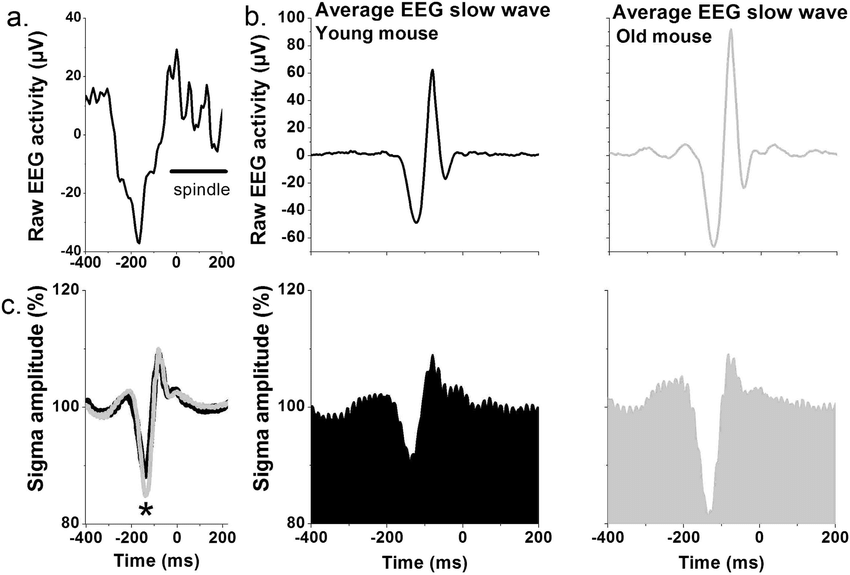
There is no noticeable eye movement in this stage. Due to interactions between the thalamic reticular nucleus and other thalamic nuclei, there are occasional brief (at least 0.5 seconds) waves of about 10–12 Hz, called “sleep spindles” or “sigma waves.”
Besides sleep spindles, you see longer-wavelength “delta waves” (frequency 1.6–4.0 Hz) about every 1–1.7 minutes, each lasting about one second, known as “K-complexes.”
Often, after each K-complex delta wave in this stage, a sleep spindle or sigma wave appears. These K-complexes bring sound and language-related data stored in short-term memory to the hippocampus, which then selects which data should go into procedural long-term memory and which into declarative long-term memory, encodes selected data for the latter, and consolidates the procedural memory data. The encoded declarative memory moves to the temporal cortex via sigma waves, as does the unencoded data to the entorhinal and perirhinal cortex. Additionally, all consolidated procedural memory data is transferred from the hippocampus to the cerebellum, putamen, caudate nucleus, and motor cortex using sigma waves.
Now, what are declarative and procedural long-term memory? If you can easily recall the content of a movie you watched three or four years ago, or your travel experiences, you’re using declarative long-term memory. But there are other things—like riding a bicycle or playing an instrument—which you don’t actively recall but still know how to do. I rode a bike for a few years but haven’t touched one for over a decade; still, I’m confident I could do it because that knowledge sits in the brain’s procedural long-term memory. Some information, though suitable for declarative memory, gets used so frequently or is so valued by the mind that it’s made essentially permanent—here, procedural memory is the fallback. Procedural long-term memory is developed through practice or repetition. The saying “Practise makes a man perfect” is absolutely true, because previous experience encoded as procedural memory lets us do things more skillfully.
Many of us worry that we didn’t get the right opportunity to apply all the skills or knowledge we’ve acquired. Looking at our careers, we sometimes sigh and think maybe we didn’t need to learn so much. But as my mother often reminds me: “Nothing you learn is ever wasted.” How? Think about this: the information we remember is the decoded form of what’s encoded in our brain, and our new ideas are essentially re-encryptions of these decoded memories. No matter what we do for a living, the brain finds a way to use every drop of knowledge and skill we’ve gained since childhood, often without our conscious awareness.
Third Stage—
Here, the data for declarative long-term memory that arrived at the entorhinal and perirhinal cortex is encoded, and the consolidated data for procedural memory is also encoded in the cerebellum, putamen, caudate nucleus, and motor cortex. This stage produces delta waves with frequencies of 0.5–2 Hz and amplitudes of 75 microvolts. Because of the slow frequency, these are called “slow waves,” and this stage is known as “slow-wave sleep.” These slow waves are the drivers of all encoding processes occurring in this third stage.
During this third stage, people sometimes dream, but these dreams are disjointed and unclear, and usually forgotten upon waking. The encoding of information in this stage can sometimes manifest as incoherent and unclear dreams.
Rapid Eye Movement (REM) Phase—
During NREM, the cerebellum maintains normal muscle tone in the skeletal muscles of the arms and legs (explaining why sleepwalking occurs during this phase) but very low tone in the upper airway muscles (so snoring persists). When REM sleep begins, the cerebellum almost eliminates muscle tone in the limbs (hence paralysis in arms and legs during REM), while muscle tone in the airway returns to normal—thus sparing bed partners from snoring during REM sleep.
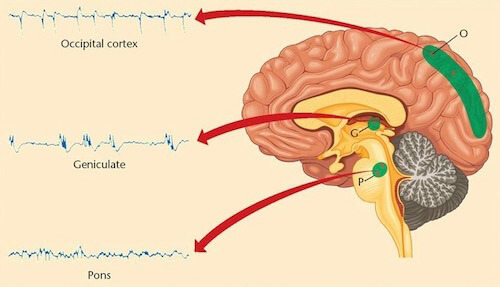
Energy expenditure in the brain during this phase is higher than during NREM or wakefulness. The part at the back of the brain connected to the spinal cord is the “brainstem” (consisting of the medulla oblongata, pons, and midbrain). During REM sleep, the pons produces a special wave, the “ponto-geniculo-occipital wave,” which flows through the lateral geniculate nucleus in the thalamus and reaches the primary visual cortex in the occipital lobe, temporarily activating it and rapidly stimulating the tonic muscles of the eye, causing the fast eye movements characterizing this phase—hence the name “Rapid Eye Movement.”
This is the phase when people experience the most vivid dreams. Declarative long-term memories encoded in the entorhinal and perirhinal cortex are consolidated and stored in the temporal cortex during REM. Likewise, procedural memories, after being encoded in the cerebellum, putamen, caudate nucleus, and motor cortex, are stored during REM. These storage processes can sometimes appear as dreams. Dreams in REM are vivid, and are remembered after waking, but they are typically disconnected from real events, lacking a cause-and-effect structure. For example, imagine reading a forty-page story not in sequence but starting from page ten and going back, then jumping to two and up to thirty, and then from forty down to twenty—your grasp of the story would be like your dream experience during REM: nonlinear and jumbled. By contrast, direct observation in waking life is sequential. Likewise, reading just a few random pages from the story won’t help you retain much detail for long; that’s like the fragmented dreams of NREM stage three.