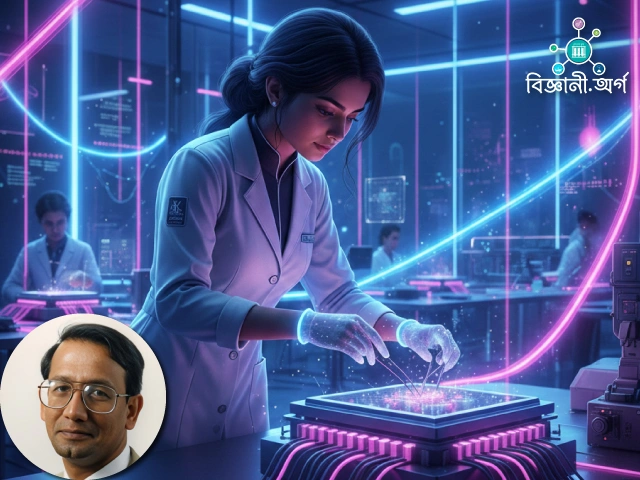
Computing technology is now an inseparable part of every layer of modern civilization. From smartphones to artificial intelligence, from medicine to space research—the need for faster and more powerful computers is increasing everywhere. But conventional electronic computer technology is gradually reaching its limits. Against this backdrop, Bangladeshi scientist Dr. Mohammad Ataul Karim has envisioned an alternative path for the future. At the center of his research lies optical computing—where calculations are performed using light instead of electricity.
Dr. Karim’s academic journey began with physics. During his studies in the United States, his research in biophysics and condensed matter physics made him realize the vast potential of applying fundamental laws of nature to technology. Later, in electrical engineering, he worked on image processing and information processing. These experiences brought him face to face with a fundamental question—how can we exponentially increase the speed and capacity of current computer technology?
While searching for answers to this question, he turned his attention to optical computing. The main idea of optical computing is to use light as a medium for carrying information. Light can travel simultaneously in many directions, allowing multiple tasks to be performed at once. To put it simply, sending information via electricity is like having cars move along a single road, whereas sending information with light is like using a multi-lane superhighway. As a result, computational speed can increase dramatically.
Another important aspect of Dr. Karim’s research is the practical application of this technology. His work on night vision displays, advanced optical sensors, and high-speed image processing systems has made significant contributions to both military and civilian fields. In particular, technology for clear vision in low light has opened new possibilities in rescue operations, security systems, and medicine.
However, his research life is not limited to technological achievements alone. As an academic leader, he has also played a pioneering role in building research infrastructure. He believes that good research doesn’t stem from individual brilliance alone; rather, it requires a supportive environment, skilled teams, and long-term planning. Guided by this philosophy, he has taken the initiative to establish new research programs and departments at various universities.
Dr. Karim’s journey is a powerful inspiration for young people in Bangladesh. He repeatedly emphasizes that world-class research is possible even with limited resources. In his view, future scientists and engineers should not be fixated on solving narrow problems; they must learn to see the bigger picture. Considering technology’s social impact, its role in human welfare, and Bangladesh’s position in the global context—setting research directions with these in mind is the key to future success.
This journey of research, moving forward at the speed of light, is thus not just a technological endeavor; it is a bright horizon of possibilities for future Bangladeshi scientists.
Read the full interview with Dr. Mohammad Ataul Karim: